

The 72 Hour Failure Plan: What Happens When Systems Break
Most failures don’t happen instantly—they unfold over time. Learn the 72-hour failure model and how systems degrade, adapt, and break in the real world.
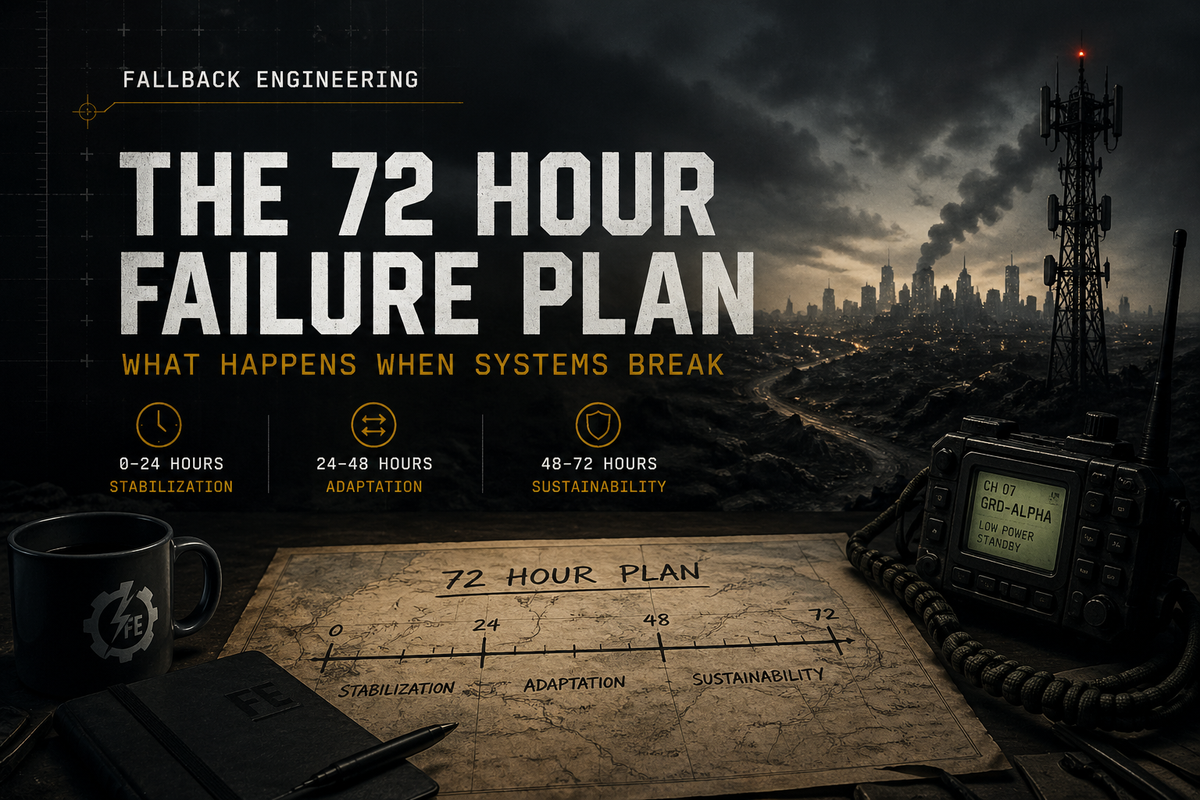
Most people think failure is an event.
It’s not.
It’s a timeline.
Systems don’t collapse all at once—they unravel. Slowly at first. Then all at once. And by the time it’s obvious, you’re already behind.
If you understand how failure unfolds, you can stay ahead of it.
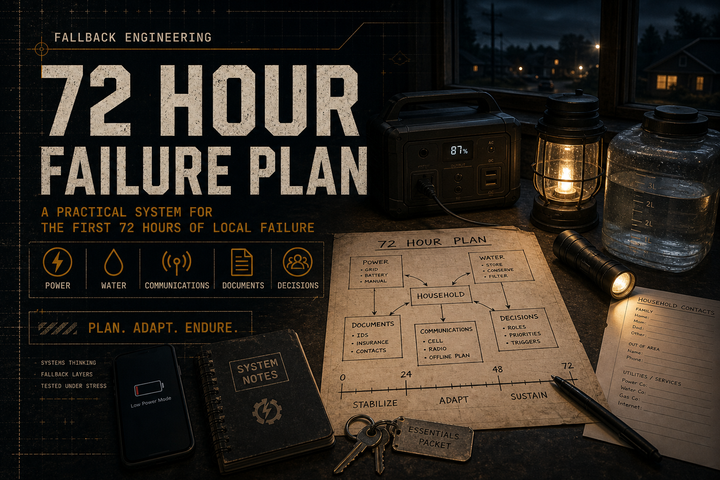
That’s where the 72 Hour Failure Plan comes in.
Failure Has Phases
When a system breaks, it doesn’t drop cleanly from “working” to “down.”
It moves through stages.
Each one changes how you think, how you respond, and what options you still have left.
Miss the phase you’re in—and you make the wrong decision at the worst possible time.
Phase 1: 0–24 Hours — Stabilization
This is where things first go wrong.
Not dramatically. Not clearly.
Something feels off:
- Intermittent issues
- Partial failures
- Alerts that don’t quite make sense
- Systems behaving inconsistently
At this stage, the biggest threat isn’t failure.
It’s misinterpretation.
You don’t know:
- What’s broken
- What’s still working
- What’s about to fail next
So you start doing what operators always do:
You try to stabilize.
You:
- restart things
- reroute around problems
- apply quick fixes
- buy time
Some of those actions help.
Some of them make it worse.
Phase 2: 24–48 Hours — Adaptation
Now the situation is clearer.
Not better—clearer.
You know something is broken, and it’s not coming back quickly.
Temporary fixes become permanent (for now).
This is where systems start to bend:
- Workflows change
- Dependencies shift
- Manual processes replace automation
- People become part of the system
This is also where hidden weaknesses show up:
- “Redundant” systems fail the same way
- Backup plans depend on the same infrastructure
- Documentation doesn’t match reality
You’re no longer trying to fix the system.
You’re trying to keep it running.
Phase 3: 48–72 Hours — Sustainability
This is where most people fall behind.
Because this is where reality sets in:
This isn’t a short-term problem.
This is the new environment.
Now you’re asking different questions:
- How long can we operate like this?
- What do we stop doing?
- What matters most?
Systems that weren’t designed for sustained failure start to break in new ways:
- People burn out
- Workarounds fail
- Data becomes inconsistent
- Small problems compound into larger ones
At this point, survival depends on intentional decisions, not reactions.
Most Systems Fail Before 72 Hours
Not because the failure was catastrophic.
But because the response was.
The pattern is always the same:
- Phase 1: Misread the situation
- Phase 2: Adapt too late or incorrectly
- Phase 3: Run out of options
Failure isn’t just technical.
It’s operational.
Why This Matters
If you think failure is a single event, you react.
If you understand failure as a timeline, you plan.
The difference is everything.
Because the goal isn’t to prevent failure entirely.
That’s not realistic.
The goal is to:
- Recognize which phase you’re in
- Make decisions that match that phase
- Avoid creating new failures while solving the current one
Where This Goes Next
The 72 Hour Failure Plan isn’t just a concept.
It’s a framework you can apply to any system:
- infrastructure
- networks
- production environments
- personal setups
We’ll break this down further:
- How to identify your system’s weak points
- How to plan for each phase
- How to build systems that survive beyond 72 hours
Because most systems don’t.
Comments ()