

Building a Personal Fallback System
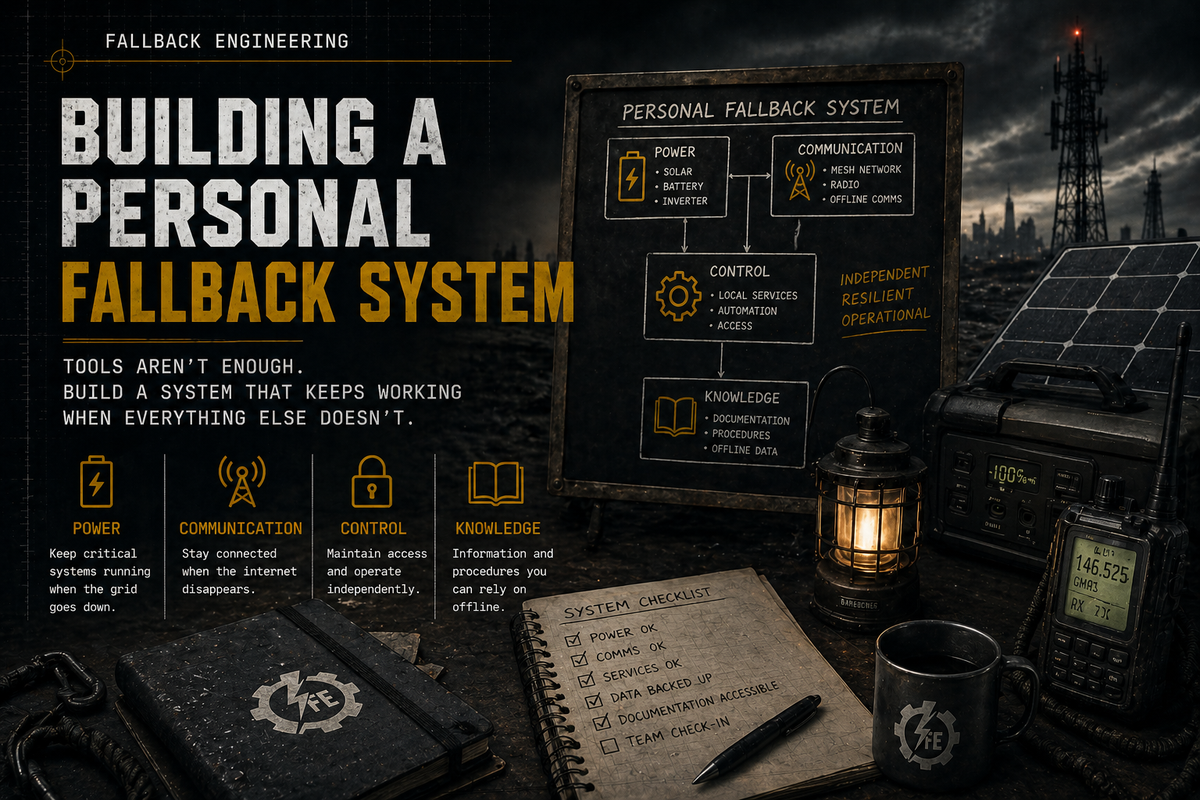
Tools aren’t enough. You need a system. Learn how to build a personal fallback system that keeps working when infrastructure fails.
Most people collect tools.
Flashlights.
Batteries.
Radios.
Backup drives.
That’s not a system.
That’s a pile of parts.
And parts don’t help you when things stop working.
A System Has Structure
A fallback system isn’t about what you own.
It’s about how things work together when everything else doesn’t.
Because when failure hits, you don’t rise to the level of your gear.
You fall to the level of your system.
What Actually Fails First
When things break, it’s rarely just one thing.
It’s layers.
- Power becomes unreliable
- Communication becomes inconsistent
- Information becomes outdated or inaccessible
- Coordination breaks down
Most people prepare for one of these.
Very few prepare for all of them at once.
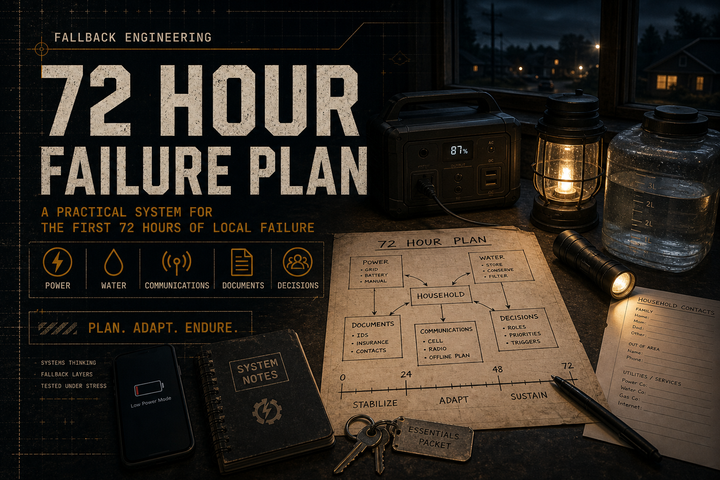
The 72-Hour Illusion
There’s a common idea:
“If you can make it 72 hours, you’re good.”
That’s not wrong—but it’s incomplete.
A typical emergency kit covers the basics:
- food
- water
- light
- first aid
Those matter. A lot.
Guidelines often recommend essentials like several liters of water per person per day, non-perishable food, lighting, radios, and critical documents
But here’s the problem:
That keeps you alive.
It doesn’t keep your system running.
You Need More Than Survival
Fallback Engineering isn’t just about getting through an emergency.
It’s about maintaining capability.
Can you:
- communicate reliably?
- access the information you need?
- make decisions with confidence?
- coordinate with others?
If the answer is no, you don’t have a system.
You have supplies.
The Four Layers of a Fallback System
If you want something that actually works, build across these four layers:
1. Power
Everything depends on it.
If power is unstable, everything above it is unstable.
Ask:
- What runs without grid power?
- How long can it run?
- What fails first when power drops?
2. Communication
If you can’t communicate, you can’t coordinate.
This is where most systems fall apart fast.
Consider:
- local communication (radio, mesh)
- device-to-device communication
- independence from internet infrastructure
If your only plan is “use your phone,” you don’t have a plan.
3. Control
Can you still operate your system?
Or does everything depend on remote services?
Look for:
- cloud dependencies
- remote authentication
- centralized control points
If control disappears when the internet does, your system isn’t local enough.
4. Knowledge
This one gets ignored the most.
When something breaks, do you know what to do?
Or is the answer:
“Google it.”
Because that won’t be an option.
You need:
- local documentation
- saved procedures
- known workflows
If the knowledge isn’t accessible offline, it doesn’t exist.
Most People Build This Backwards
They start with gear.
Then try to figure out how to use it.
That’s backwards.
Start with:
- What needs to keep working
- What failure looks like
- What decisions you’ll need to make
Then build the system to support that.
This Is Where Things Change
Once you start thinking this way, everything looks different.
You stop asking:
- “What should I buy?”
And start asking:
- “What breaks if this goes away?”
That’s the shift.
That’s Fallback Engineering.
Where This Goes Next
This is just the starting point.
From here, we can go deeper:
- Designing communication systems that don’t rely on infrastructure
- Building local dashboards and monitoring systems
- Creating distributed systems that survive failure
Because a real fallback system isn’t a kit.
It’s an architecture.
Comments ()