

You Have a Single Point of Failure (You Just Haven’t Found It Yet)
Single points of failure aren’t just in data centers—they’re in your home, your tools, and your daily systems. Learn how to find them before they take everything down.
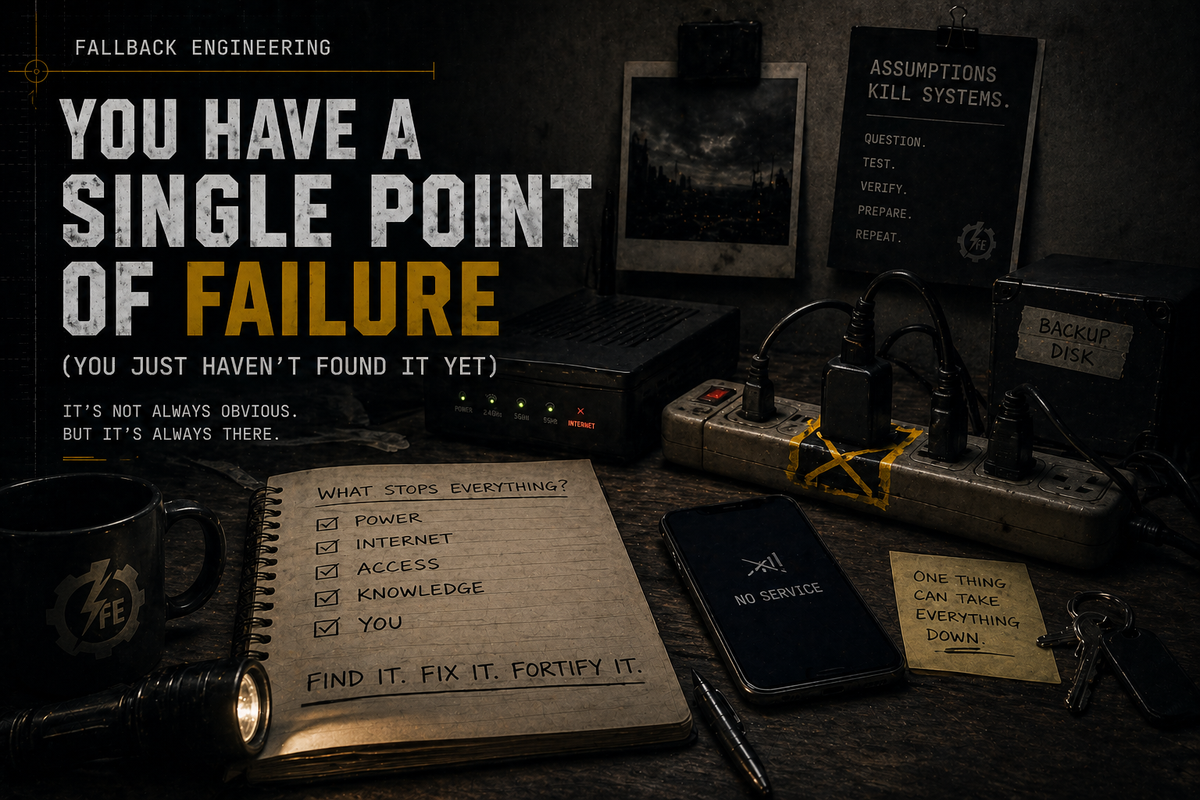
It’s not in a rack.
It’s not in a diagram.
And it’s probably not where you think it is.
But it’s there.
Something in your setup—your home, your tools, your routines—can fail and take more with it than you’re ready for.
You just haven’t tripped over it yet.
This Isn’t Just a Technology Problem
When people hear “single point of failure,” they think servers.
Networks.
Data centers.
Enterprise systems.
That’s not where this matters most.
Your real exposure is closer than that:
- The one outlet everything depends on
- The one device that controls everything else
- The one way you access critical information
- The one person (you) who knows how it all works
That’s your system.
And it’s more fragile than it looks.
It Looks Fine—Until It Doesn’t
Most single points of failure don’t look like risks.
They look like convenience.
- One app that controls all your devices
- One password manager you can’t access offline
- One power strip feeding your entire setup
- One internet connection everything assumes exists
Everything works.
Until that one thing doesn’t.
Then everything stops at once.
The Problem Is Dependency Stacking
No single issue feels critical.
But they stack.
- Power → feeds your devices
- Internet → connects your tools
- Device → controls your systems
- Knowledge → tells you what to do
You lose one layer…
…and suddenly the others don’t matter.
Let’s Make It Real
Kill the power.
What still works?
Kill the internet.
What becomes useless?
Lose your phone.
What can you no longer access?
Forget your passwords.
What are you locked out of?
That’s your system under stress.
That’s where your weak points are.
The Worst One Is Invisible
The most dangerous single point of failure isn’t hardware.
It’s access.
If you can’t:
- log in
- retrieve information
- execute a plan
Then it doesn’t matter what tools you have.
You’re locked out of your own system.
And Yes—You Are One Too
If everything depends on you:
- remembering how it works
- being available
- being able to fix it
Then you’re part of the failure chain.
If you’re tired, unavailable, or overwhelmed…
The system degrades with you.
How to Actually Find Them
Don’t diagram your system.
Break it.
Walk through simple scenarios:
1. Remove Power
What stops immediately?
What shouldn’t?
2. Remove Connectivity
What becomes inaccessible?
What assumed the internet would always be there?
3. Remove Access
No logins. No saved sessions.
What can you still control?
4. Remove Yourself
If you’re not there, can someone else:
- understand it
- operate it
- recover it
If not, you’ve found your biggest risk.
Most People Don’t Discover These Early
They discover them during failure.
When:
- time is limited
- stress is high
- options are few
That’s the worst time to learn how your system actually works.
Why This Matters
You don’t need a perfect system.
You need one that doesn’t collapse from a single point of failure.
Because when one thing breaks, it shouldn’t take everything with it.
That’s the difference between inconvenience…
…and failure.
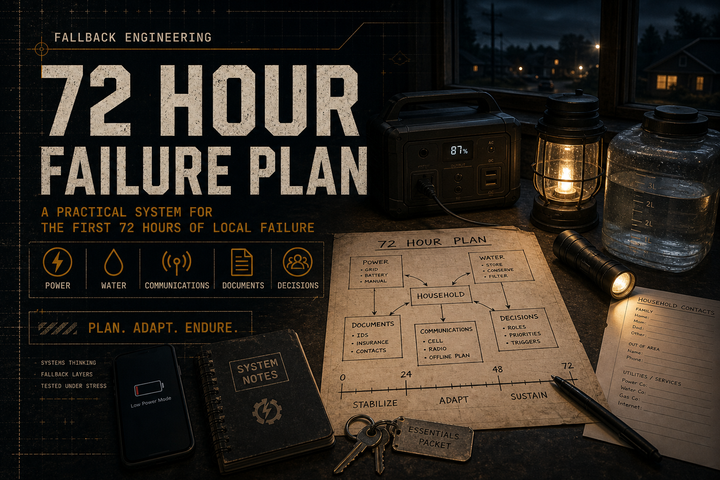
Where This Fits in the 72 Hour Plan
This is what defines your starting point.
If your system has hidden dependencies:
- Phase 1 becomes confusion
- Phase 2 becomes improvisation
- Phase 3 becomes loss of capability
If you’ve already found them:
- Phase 1 becomes controlled
- Phase 2 becomes manageable
- Phase 3 might not happen at all
Comments ()