

Failure Doesn’t Look Like You Think
Real system failures aren’t dramatic—they’re subtle, partial, and easy to ignore. Learn why the most dangerous failures don’t look like failures at all.
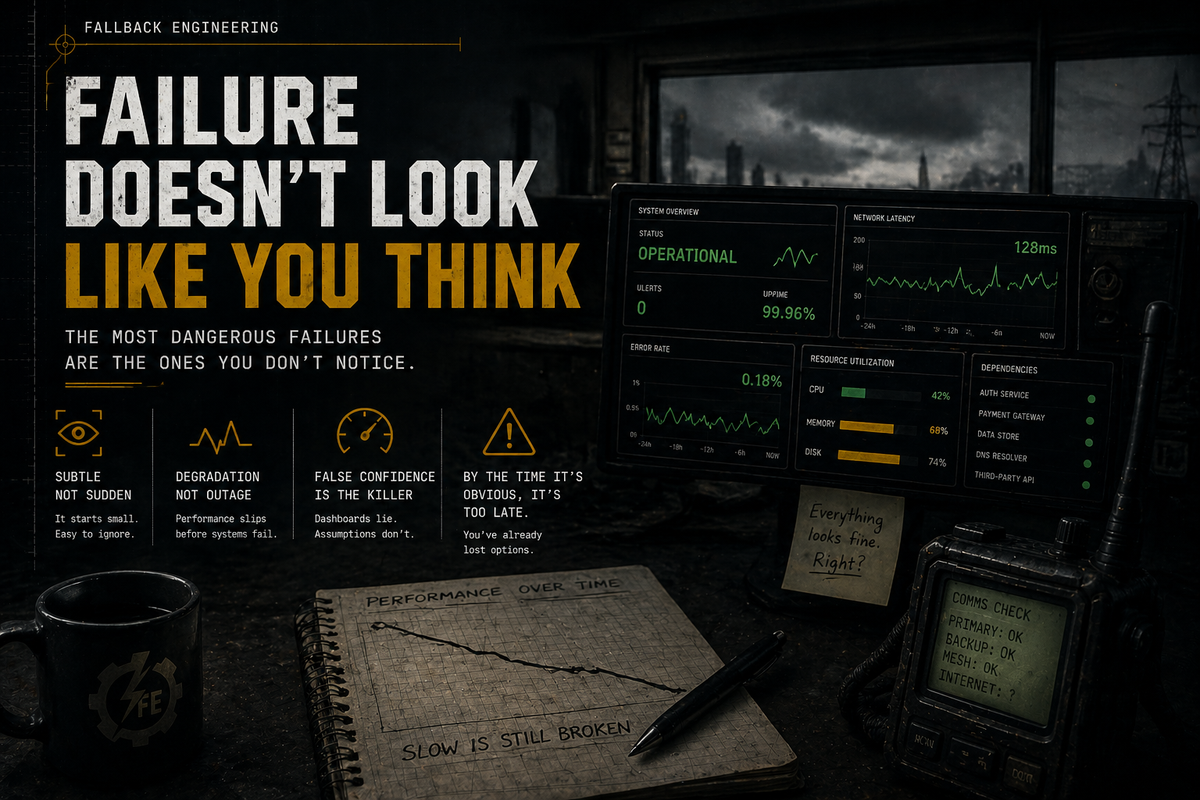
Most people expect failure to be obvious.
Alarms going off.
Systems going dark.
Everything stopping at once.
That’s not how it happens.
Real failure is quieter than that.
It Starts With Something Small
A delay that wasn’t there yesterday.
A dropped packet.
A system that takes a little longer to respond.
Nothing breaks.
Nothing stops.
So you ignore it.
Because everything is mostly working.
Partial Failure Is the Dangerous One
Total failure gets attention.
Partial failure gets tolerated.
That’s the difference.
When everything goes down, you react immediately.
You escalate.
You fix it.
But when things sort of work?
You adapt.
You:
- retry
- refresh
- reroute
- work around it
And every workaround pushes the system further from how it was designed to operate.
The System Is Lying to You
Monitoring says everything is fine.
Or at least… not critical.
Dashboards stay green because the thresholds weren’t designed for reality.
Redundancy kicks in—but it’s slower, weaker, or already compromised.
From the outside, the system looks stable.
From the inside, it’s degrading.
False Confidence Is the Real Failure
The most dangerous state isn’t failure.
It’s thinking you haven’t failed yet.
Because that’s when decisions get made based on bad assumptions:
- “It’s just a temporary glitch.”
- “We’ve seen this before.”
- “It’ll stabilize on its own.”
Sometimes it does.
Until it doesn’t.
Degradation Compounds
Small issues don’t stay small.
They stack.
- A slow system causes retries
- Retries increase load
- Increased load causes more failures
- More failures trigger more workarounds
Now the system isn’t just degraded.
It’s unstable.
And no single issue explains why.
Redundancy Doesn’t Save You
Not if it’s built on the same assumptions.
Backup systems often fail the same way:
- Same network
- Same dependencies
- Same misconfiguration
- Same blind spots
So when the primary system degrades…
The backup quietly follows.
By the Time It’s Obvious, It’s Too Late
Eventually, the system does fail in a way you can’t ignore.
But by then:
- You’ve lost clean data
- You’ve lost time
- You’ve lost options
You’re no longer responding to a failure.
You’re reacting to the consequences of one that’s been building for hours—or days.
What You Should Be Looking For
Failure leaves signals long before it breaks anything.
You just have to take them seriously.
Look for:
- Inconsistent behavior instead of outright failure
- Increased latency without clear cause
- Systems that require more “nudging” to work
- Workarounds becoming routine
- Alerts that don’t quite line up with reality
If something feels off—it is.
Why This Matters
If you’re waiting for failure to be obvious, you’re already behind.
Because the most dangerous failures don’t announce themselves.
They blend in.
They look like:
- inconvenience
- noise
- normal variation
Until they aren’t.
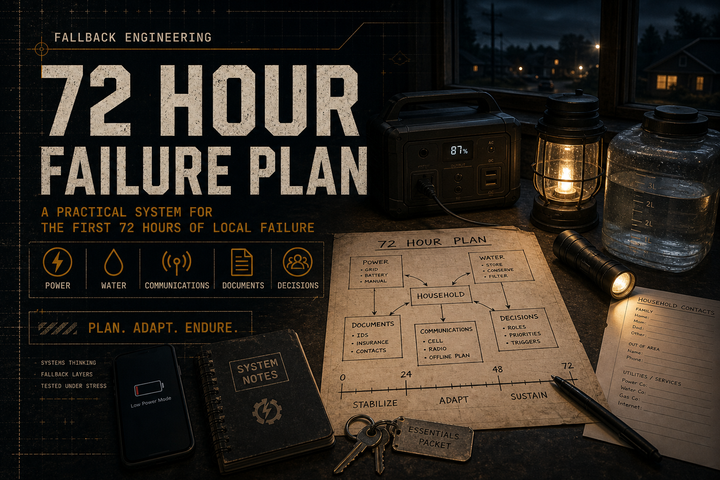
Where This Fits in the 72 Hour Plan
This is Phase 1.
The part most people miss.
Because nothing looks broken yet.
But this is where you still have the most control.
Miss this phase—and everything that follows gets harder.
Comments ()